Here is what usually happens before a first meeting. You send a warm intro with your deck attached. The investor reads the email on their phone, between two other calls, and does what everyone does with a name they don’t know: they tap the link in your signature.
They spend about thirty seconds there. Then they decide whether to open the deck now, later, or never.
You worked on that deck for weeks. You probably haven’t looked at your homepage since launch, and it was written for customers, not for this person.

Your site is doing a job you didn’t hire it for
Most early-stage sites are built to convert buyers. That’s correct. But in a fundraise, the site does a second job: it’s the cheapest piece of diligence an investor will ever do, and it happens before you’re in the room to explain anything.
First impressions online are mostly about whether the site looks credible. In Stanford’s Persuasive Technology Lab study of more than 2,600 people judging real websites, the site’s design and look was the most-mentioned factor in deciding whether to trust it, cited in 46.1% of comments (Fogg et al., 2003). People were judging the company by the page.
And the bar is higher this year. Seed money is going to companies that can show they’ve already proved something. The median seed valuations falling from $35M to $23M in a single quarter. When investors are pickier, the thirty-second skim matters more, not less.
The trouble is that you can’t skim your own site. You know what “Smarter operations for modern makers” means. An investor doesn’t.
The Forward Test
Here’s the question to ask about your homepage: if an investor liked what they saw, could they forward it to their partner with one line, “worth a look, they do X for Y”?
If they’d have to write the X and Y themselves, they won’t forward it. Five checks get you there:
1. Clarity: name the customer and the problem in the headline. “Inventory forecasting for independent coffee roasters” beats “Smarter operations for modern makers” every time, even though the second sounds bigger. Investors can size a market they can name. They can’t size “makers.”
2. Credibility: one number and one face. Your deck says you have 41 paying customers. Does your site? Founders often keep traction out of public view by habit. A single, honest figure (”used every week by 40+ roasters”) and a team page with real names do more than a page of testimonials.
3. Market: put the problem in your customer’s words. Your sharpest line about the pain you solve is probably buried in a blog post or a sales email. Move it to the homepage, right under the headline.
4. Trust signals: look like a company that will exist next year. Pricing, a privacy policy, a company email address, a footer that isn’t half-empty. These are boring, and missing ones are noticed.
5. The Ask: give an investor a door. If the only call to action is “Book a demo,” an investor has nowhere to go. A short About page with the founders, why you, and a contact link is enough. You don’t need an “Investors” page. You need one place that says a human runs this.
The hardest part is reading it cold
You can run the Forward Test yourself, and you should. But there’s one exercise that beats any checklist:write down, in one sentence, what you think a stranger would say you do after 30 seconds on your homepage. Then ask three people who’ve never seen it.
The gap between those two sentences is the size of your positioning problem. Most founders are surprised by it. The product is clear in your head and blurry on the page.
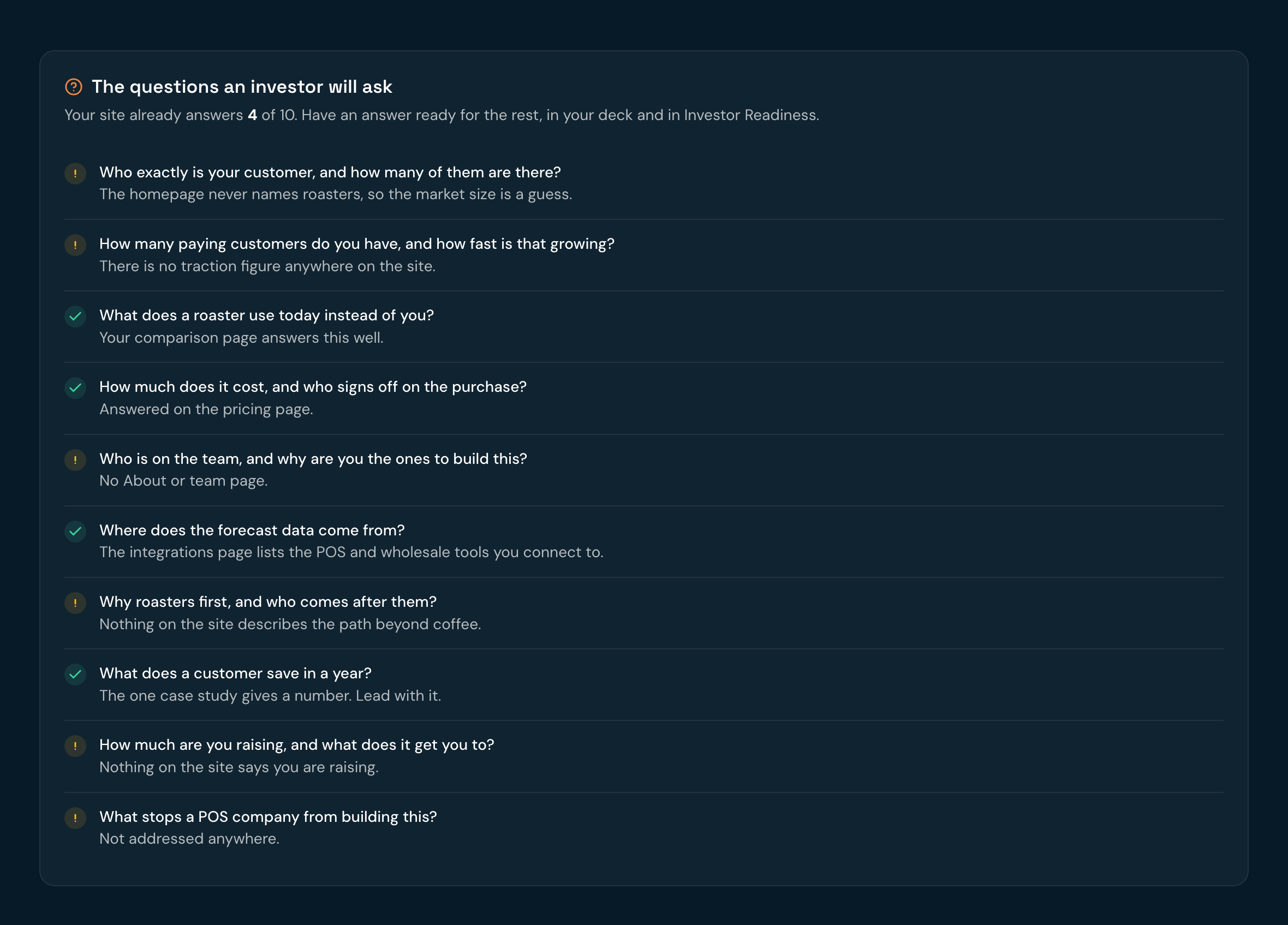
The second exercise: list the ten questions an investor will ask after reading your site, and mark which ones the site already answers. “How many customers?” “Who’s on the team?” “Why now?” Every unanswered one is a question you’ll get in the meeting with no warning, or worse, one the investor answers for you, with a guess.
We built this into the OS
We got tired of telling founders to “read your site like an investor” when nobody can actually do that with their own words. So the new InPaceline OS does it for you.
On the Website page there’s now an Investor view tab. It reads your site the way an investor would.
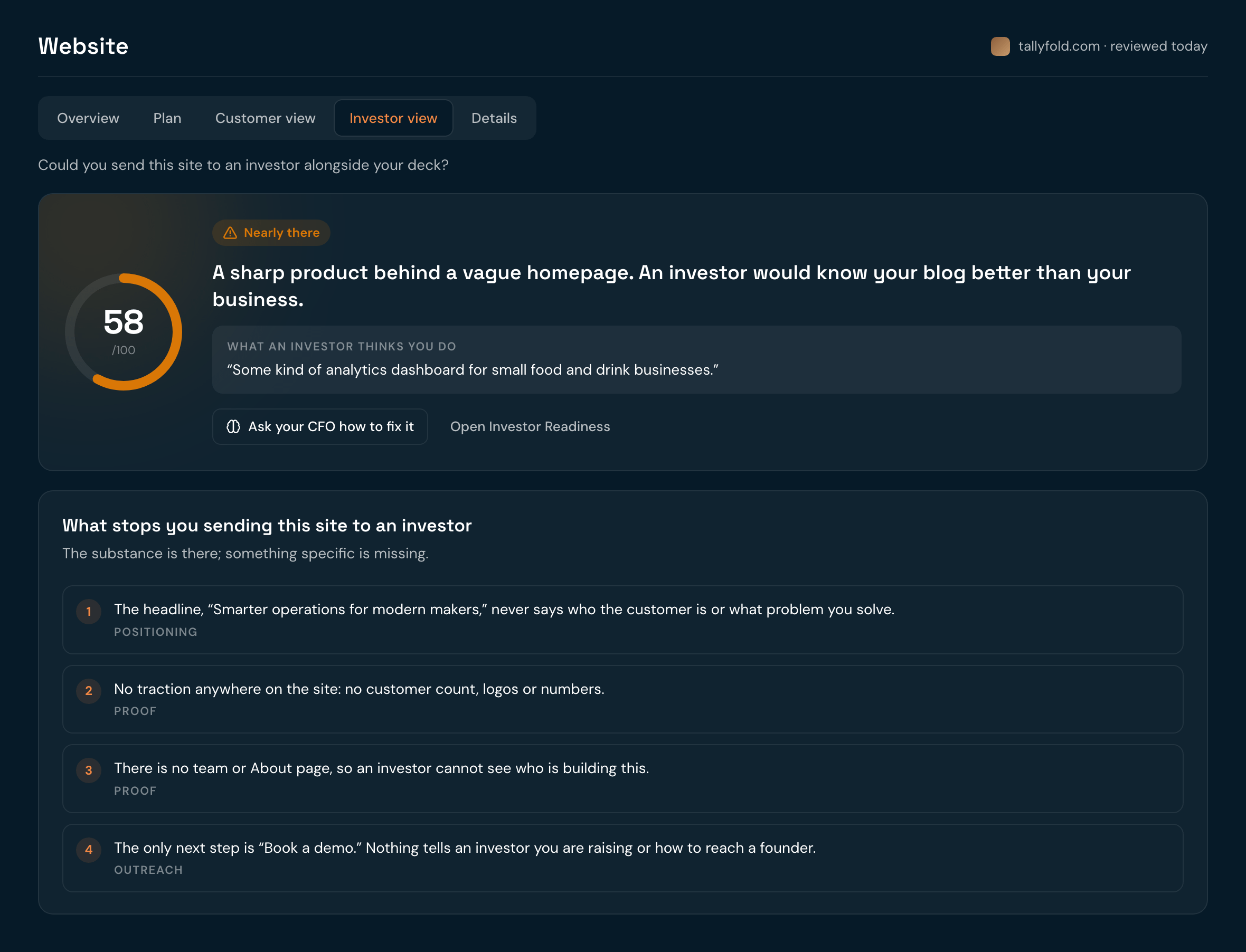
The top of the Investor view: a 0–100 score, a one-line verdict, and the sentence an investor would use to describe your company. If that sentence is wrong, nothing else matters yet.
The box we’d point you to first is ”What an investor thinks you do.” It’s the one-sentence exercise above, done for you, with no friends required. Below it are the specific blockers keeping your site out of an investor’s inbox, each tagged positioning, proof or outreach.
Then the five checks from the Forward Test, scored:

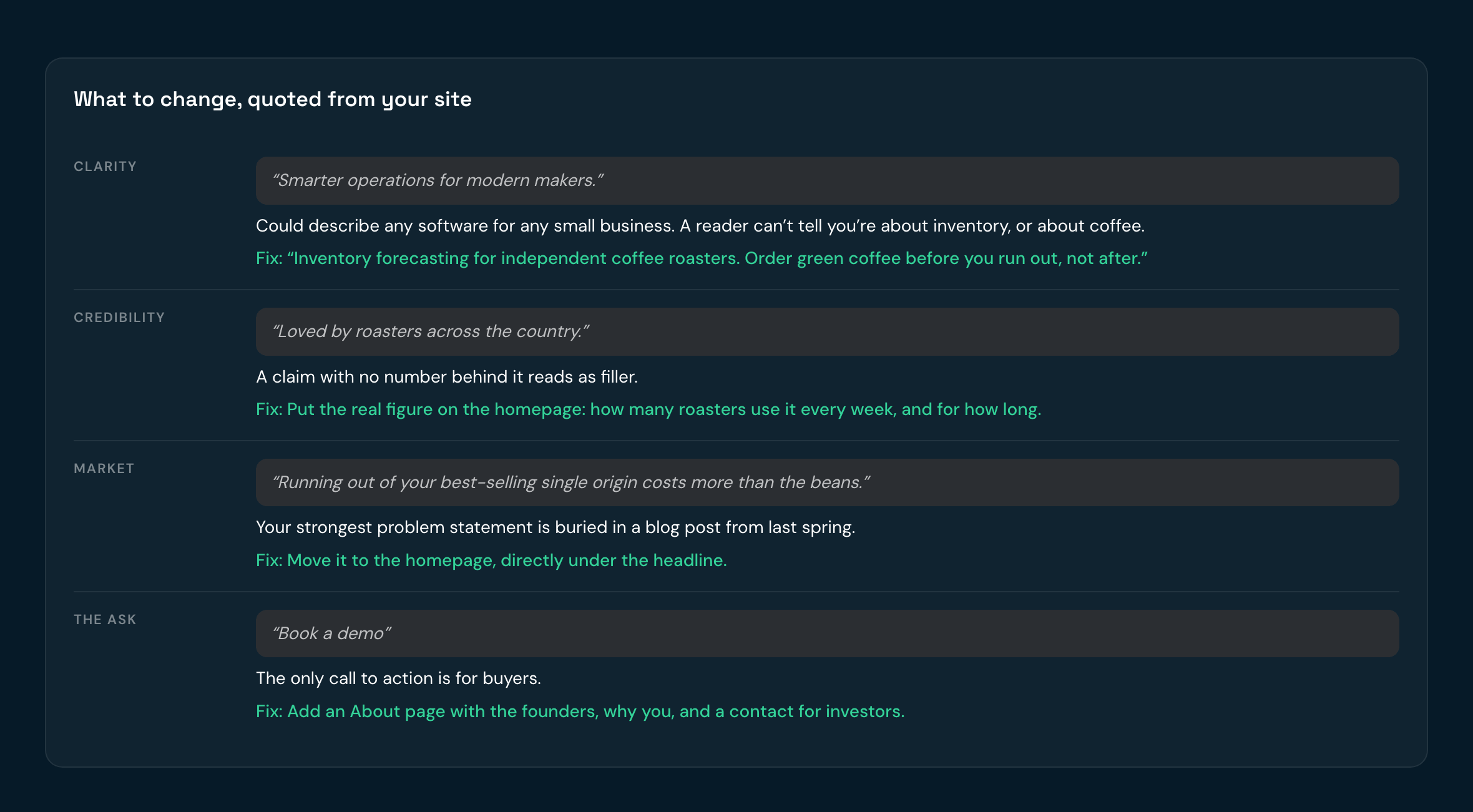
Every finding quotes your own copy back to you, with a fix:
And finally, the ten questions an investor will ask after reading your site, marked by whether your site already answers them:
If your company is marked as raising, the full investor read runs automatically with every website review. Otherwise it’s one click and about a minute.
Fix the page they see first
You’ll spend another month polishing slide 7. Spend one afternoon on the page an investor sees before slide 1.
Run the Forward Test. Rewrite the headline so it names a customer. Put one real number where people can see it. Give investors a door. Then read it cold again and see whether the sentence a stranger would write now matches yours.
Try it on your own site. Our Free Website Clarity analyzer reads your website as an investor would, tells you what stops you sending it, and drafts the fixes. Enter your URL and get the investor view in about a minute at https://inpaceline.com/clarity.