Here’s a number we didn’t expect to be this clean.
Of the founders using the FounderOS, 27 uploaded more than one version of their pitch deck. 19 of them ended with a higher score than they started with. The typical founder gained 10 points, with an average of 11.5. A few jumped 25 or even 40 points.
It’s tempting to look for the trick behind those numbers: a magic slide order, a killer opening line, a template. There isn’t one. The founders who improved all did the same boring thing. They uploaded again.
Why the first draft scores low
Your first deck almost always scores lower than you think it deserves, and not because you’re bad at this. It’s because you know your company too well.
You know why the problem matters, so you skip explaining it. You know the market is big, so you put up a number without saying where it came from. You know what you’ll do with the money, so the ask slide just says “$500K.” An investor reading cold doesn’t know any of that. Every gap you can’t see is a gap they can.
That’s why a low first score is useful rather than embarrassing. It’s the first honest read your deck has had from someone who doesn’t already believe in you.
What the 19 founders did differently
When we looked at how the improvers worked, a pattern came up quickly.
They fixed slides, not “the deck.” “Make the deck better” is too big a task to start, and anything that big gets put off. “Rewrite the problem slide so it describes a customer, not a feature” is a 20-minute job. The founders who climbed treated their audit as a list of small, specific jobs.
They uploaded before it felt finished. Several founders ran a second version within a day or two of the first. They didn’t wait for a perfect rewrite. They fixed the top few issues and checked whether the fixes landed. One founder went through eight versions in three weeks.
They accepted the dips. Not every upload went up. Fixing one slide sometimes weakened another, such as a sharper market slide that no longer matched the business model slide. The improvers treated a dip as information. They looked at what changed, kept what worked and undid what didn’t.
They kept going after “good enough.” The typical gain was 10 points, but the biggest climbs came from founders who kept iterating after the first round of fixes. The difference between a deck that gets skimmed and a deck that gets a meeting is often the last 10 points, not the first 30.
Where a better deck leads
A score is a proxy. The real goal is what happens after you hit send.
Greg Prosser, founder of Hansel Medical, describes the arc from the start:
“When I first engaged with him, I was solo-foundering things. My pitch deck and story had much to be desired. Since then, I’ve closed our Pre-Seed round with amazing strategic investors.”
The same pattern of naming the problem, fixing it and doing the next thing shows up beyond fundraising. Katherine Mead, founder and CEO of Planning Partner, put it this way:
“Before working with Clay, I was sitting in a lot of analysis paralysis. Now I have a long list of warm prospects and several who are close to buying. All of the tools are concrete and applicable, and my business has grown as a result.”
Analysis paralysis and an unrevised deck are the same problem. Both are a founder waiting until it’s perfect. The way out is the same too: one concrete fix, then the next.
What’s new in InPaceline 2.0
We built 2.0 around one idea: you do one small thing, and the OS does the heavy lifting. Watching founders iterate on their decks showed us what slowed them down, and we rebuilt the product around getting them to the next version.
The Pitch Deck Analyzer, rebuilt around the second upload.
A fix plan, not a report. Every weak slide becomes one specific fix, and any fix can become a task. When a later upload passes that slide, the task closes itself.
Versions, compared automatically. Each new upload is scored against your last one, so you can see which slides improved and which slipped.
Investor view. See the questions a skeptical investor would ask about your deck before you’re in the room.
Ask about your deck. An AI CFO that has read your deck and your company’s numbers explains why a slide scored the way it did and what to fix next.
Website review, which works the same way. Your website is often the first thing an investor or customer checks, sometimes before they open your deck. So we gave it the same treatment:
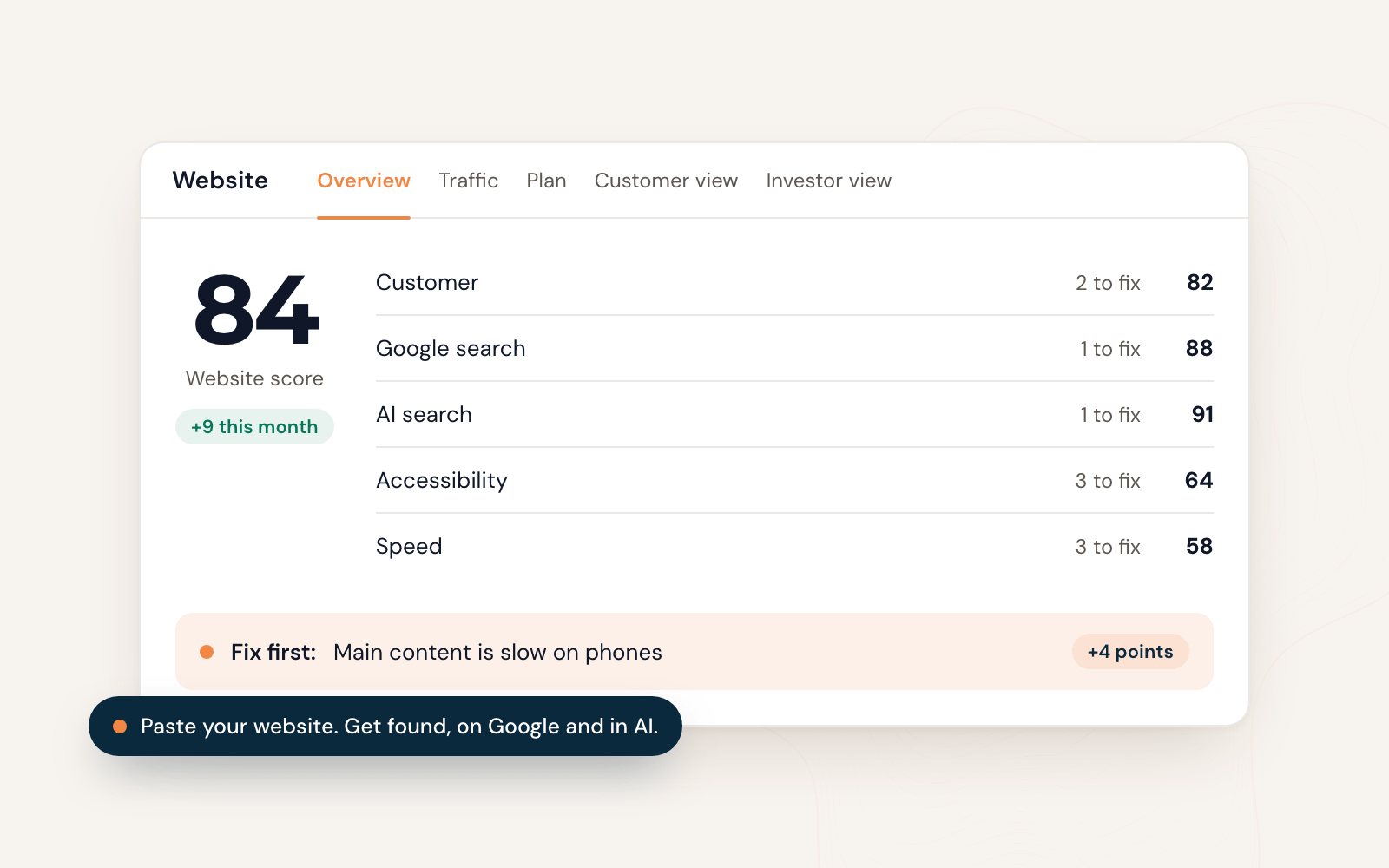
A score with an improvement plan. Enter your URL and the OS reviews your site across speed, clarity, accessibility and AI search, meaning whether tools like ChatGPT and Perplexity can understand and cite you. Every issue comes with a step-by-step fix guide and the points it’s worth.
An investor lens. Switch the review to read your site the way an investor would. Is it clear what you do, who it’s for and why now?
“Build next.” Once the basics are fixed, the OS suggests pages your site is missing, based on your kind of business and your real sitemap, so there’s always a next step.
Check any page. Paste a link, including a preview link before you publish, and get it checked against the same rules.
A chat that reads your pages. Ask “what’s wrong with my pricing page?” and the AI reads that page live and answers about it specifically. It can suggest fixes and tasks, and you add each one with a tap.
Setup that does the first pass for you. Drop in your website, and your deck if you have one. In under a minute, the OS fills in your company profile and builds a 90-day plan. It also matches you with relevant investors and grants. One number for how ready you are, with the next moves that would raise it. It never overwrites anything you’ve already entered. It only fills in the blanks.
Upload again
The most useful finding from those 27 founders is also the simplest. Almost none of them improved on the first try, and almost all of them improved by trying again.
If your deck has been sitting in a folder since the last time you sent it, it isn’t finished. It just hasn’t had a second version. Upload it this week, fix the top three things, and upload it again. If the numbers hold, you’ll be up about 10 points, and you’ll know exactly why.