Grey blocks with no labels covered parts of Jeff Weiner’s calendar when he ran LinkedIn. Anyone looking at it might have assumed a sync error. The blocks were buffers, stretches he deliberately kept free of meetings, and they added up to somewhere between 90 minutes and two hours a day.
The habit struck him as a luxury early on, and he later decided he couldn’t do the job without it. He put it plainly: “The buffer is the best investment you can make in yourself.”
You are not running LinkedIn. You probably can’t protect two hours a day, but you can protect one hour a week.

Why your week runs you
Founders like to think the reactive phase is temporary, that with more money and more people the calendar will finally belong to them. The data says otherwise.
Harvard tracked 27 big-company CEOs for 13 weeks each. Only 43% of their hours went toward their own agenda. Reactive work swallowed another 36%, and nearly nine in ten of them dealt with a crisis of some kind while the study was running.
These are people with assistants, chiefs of staff and companies averaging $13.1 billion in revenue. If they lose a third of their time to whatever shows up, you are not going to hire your way out of it.
It is worse for small companies. In one survey of business owners, strategic work got about 32% of the week, even though 73% said that is where they would rather spend it.
Hours are not what’s missing. Most founders never stop to look at where their hours went.
The one-hour review
Pick a slot and defend it. Friday afternoon works because the week is fresh and nobody books meetings then. Close Slack, open a blank doc, and answer five questions. Give each one about ten minutes.
1. Did the number move?
Pick one metric that matters right now. It might be revenue, active users, or demos booked. Write down where it was last week and where it is now, then write one sentence on why. If you can’t explain the change, you have found your first problem.
2. How many months do I have?
Check cash in the bank and what you spent this month, then divide. Runway is the one number that turns every other decision from abstract to urgent, and it changes faster than you think. Looking at it weekly means you never get surprised by it.
3. What did customers tell me?
List every customer conversation, support ticket and cancelled account from the week. Look for anything said twice. One complaint is an anecdote. Two is a pattern worth an hour of your time next week. If the list is empty, that is your answer: you did not talk to enough customers.
4. Where did my time actually go?
Open your calendar and sort the week into two piles: things you chose and things that happened to you. You are not aiming for zero reactive work. That is impossible, as the CEO study shows. You are trying to notice when the second pile keeps winning. The Harvard researchers recommended the same check to their CEOs, only quarterly. At your stage, things move too fast for that.
5. What is the one thing for next week?
Choose one thing. Write the single outcome that would make next week a success, then write what you are dropping to make room for it. The second half matters more, because a priority means nothing until something else has been cut for it.
Use the last ten minutes to write your answers down. Next Friday, start by reading them. In a month you will have a record of what you believed, what you tried and what happened. Most founders have no such record.
What this hour buys you
The review will not make your week calmer. Fires will still start, and you will still put them out.
What changes is that you see drift early. You notice in week two that the metric stopped moving, not in month three. You notice that you have not spoken to a customer in ten days. You notice that the thing you called your top priority got four hours while email got fifteen.
Weiner’s point about buffers was that a leader who never stops to think ends up reacting to the business instead of shaping it. An hour a week is the smallest version of that discipline. It takes about 2% of a 50-hour week, and it decides how you spend the other 98%.
Block it now, before you close this tab. Label it or leave it grey, as long as nobody else can book it.
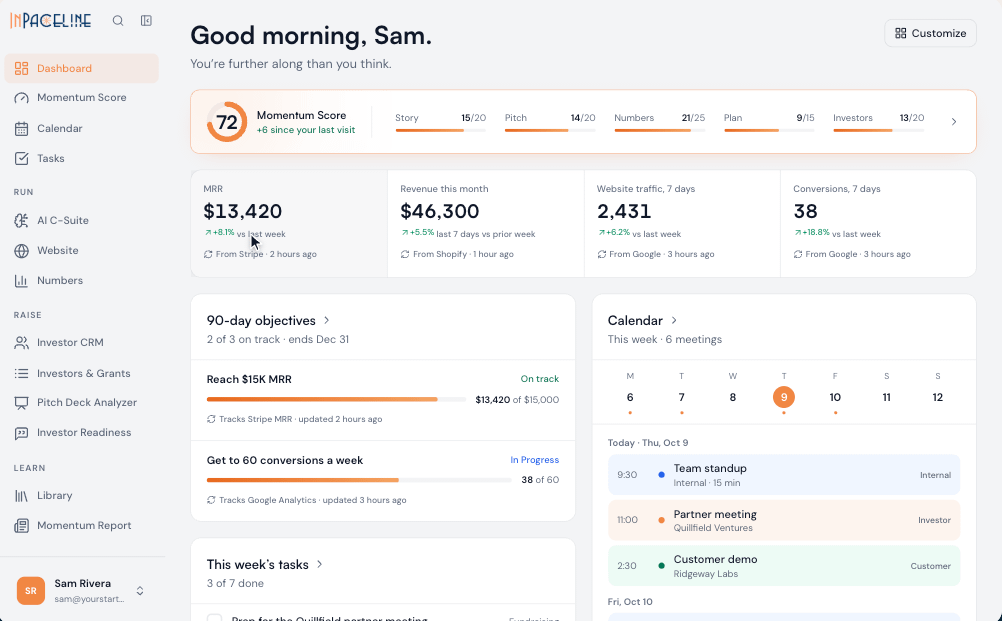
Your weekly review goes faster when the answers are already in one place. Inpaceline OS keeps your runway numbers current and gives you an AI advisor to pressure-test next week’s priority before you commit to it. Start at inpaceline.com.