It’s 9:40 on a Tuesday. You open Claude, paste in your positioning doc, your ideal customer profile, and the three paragraphs that explain what your product actually does. Then you ask for a launch email. It’s fine. Not great, but fine.
Tomorrow you’ll paste the same three paragraphs again.
That’s the hidden tax most founders pay on AI. The tool is smart, but it starts from zero every time. You end up as the bottleneck, re-briefing a brilliant intern who never remembers yesterday.
There’s a better way to work, and it’s been hiding in plain sight for about a year.
What a skill actually is
A skill is a folder with a single file inside it called SKILL.md. That file holds instructions, templates, and checklists for one specific job. The AI reads a short description of every skill you’ve installed, and only loads the full instructions when a task calls for it.
Anthropic introduced the idea in October 2025. Barry Zhang, Member of Technical Staff at Anthropic, framed it as being “like putting together an onboarding guide for a new hire.” That’s the right mental model. You’re not writing prompts anymore. You’re writing the doc you’d hand a new employee on day one.
It also isn’t locked to one tool. Roughly 40 platforms support the open standard as of mid-2026, including Cursor, GitHub Copilot, VS Code, Claude Code, Claude, OpenAI Codex, and Gemini CLI. Write it once, use it everywhere.
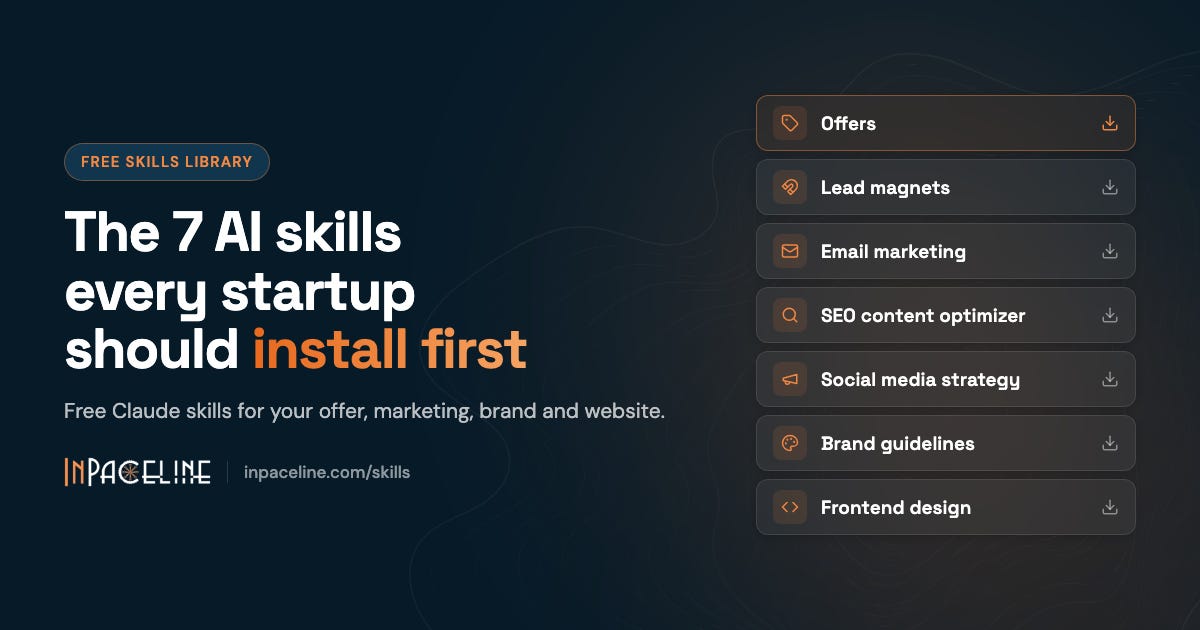
The seven worth installing first
You don’t need fifty skills. You need the handful that cover the work you keep doing badly or doing twice. For most early-stage teams, that’s your offer, your audience, and your brand.
1. Offers. Most “we need better copy” problems are really “we need a better offer” problems. This skill is built on Alex Hormozi’s value equation from $100M Offers: value goes up with the dream outcome and the buyer’s belief they’ll get it, and down with time delay and effort. It then checks your offer for six parts: core deliverable, bonuses, guarantee, urgency, name, and price. It’s strongest for services and high-ticket B2B. If you run self-serve SaaS, use it for the framing and spend more time on pricing tiers.
2. Lead magnets. This one answers the question every founder asks eventually: what should I give away for an email address? It matches the freebie to where the buyer is, from awareness to decision, and keeps you honest about effort. A checklist takes an hour or two. An ebook takes weeks. Start with the checklist.
3. Email marketing. Your email list is the only channel you truly own, and the lead magnet is only worth something if you follow up. This skill gives you a seven-email welcome sequence spread over 14 days, subject line formulas with a testing matrix, and a segmentation framework. If you’ve been “meaning to set up a welcome sequence” for six months, this is your sign.
4. SEO content optimizer. This one sorts keywords by intent: commercial (people ready to buy), informational (people learning), and navigational (people looking for you). It then enforces the boring stuff that actually moves rankings, like 50 to 60 character titles, 155 to 160 character meta descriptions, and a hub and spoke linking structure. Run every blog post through it before you hit publish.
5. Social media strategy. The most useful part is the platform prioritization matrix. It forces you to pick one or two channels based on where your buyers actually are, instead of posting thin content across five. It also covers content pillars, batching, and which metrics matter for which goal.
6. Brand guidelines. Out of the box, this skill ships with a big AI company’s colors and fonts. Swap in your own hex codes and typefaces, and every deck, doc, and one-pager your AI produces comes out on brand. It’s the cheapest brand consistency you’ll ever buy.
7. Frontend design. You’ve seen the AI-built landing page. Purple gradient, generic font, three feature cards in a row. This skill pushes the AI to commit to a real aesthetic direction before it writes a line of code. Your site stops looking like everyone else’s weekend project.
The shift
The founders getting the most out of AI right now aren’t the ones with the cleverest prompts. They’re the ones who stopped writing prompts and started writing onboarding docs. Every hour you spend on a skill is an hour you stop spending re-explaining your business to a machine.
So pick the one task you re-brief AI on most often. Install the skill for it this week.
All seven are free to download in the Inpaceline skills library at inpaceline.com/skills. Pair them with Inpaceline OS, where your AI C-Suite advisor already knows your business, so you never paste that positioning doc again.