
Best All-in-One Platform for Early-Stage Startup Growth 2026
Introduction
The best all-in-one platform for early-stage founders is the one that replaces your scattered stack of point tools with a single system for raising money, modeling runway, and getting strategic advice on demand. Most founders in the 0 to $1M phase don't fail from lack of ideas, they fail from switching between eight disconnected apps and losing the thread on what actually moves the needle. In 2026, the platforms winning founder attention bundle fundraising, financial intelligence, and AI-driven mentorship into one workflow. Consolidation isn't a nice-to-have anymore, it's the difference between fundraising on schedule and burning three months rebuilding your investor tracker in a spreadsheet.
Key Takeaways:
An all-in-one platform beats a fragmented stack because fundraising, modeling, and coaching stay connected in one place.
The features that matter most are an investor CRM, financial modeling, an AI pitch deck analyzer, and access to human coaching.
Founders should judge a platform by whether it shortens the path from idea to funded traction, not by feature count.
Why Consolidation Wins in 2026
A fragmented tool stack costs you more than subscription fees. It costs context. When your investor list lives in one app, your financial model in another, and your pitch feedback in a Slack thread, nobody sees the full picture, least of all you. The founders who move fastest treat their tools as one operating system, not a pile of logins.
The Real Cost of a Scattered Stack
Every disconnected tool adds friction, and friction kills momentum during a raise. Founders who juggle separate platforms report the same recurring problems, and most of them are avoidable with a unified setup.
Lost context: Investor notes, deck versions, and runway numbers never sit side by side, so decisions get made on partial information.
Wasted hours: Manual data entry across tools eats time you should spend talking to customers and investors.
Version chaos: Three copies of your financial model means nobody trusts any of them.
Higher spend: Five specialized subscriptions usually cost more than one platform that does the core jobs well.
Slower fundraising: Disconnected workflows stretch a six-week raise into a four-month grind.
What a Unified Growth System Actually Solves
A unified system keeps your capital-raising, modeling, and strategy in one loop, so an update in one place shows up everywhere it matters. Contemporary early-stage growth strategies lean hard on this integration, because survival signals for new ventures now depend on speed and clarity more than headcount. When your financial model connects directly to your investor conversations, you answer diligence questions in minutes instead of days. That responsiveness is what makes investors take a first-time founder seriously.
Comparing Your Options for Early-Stage Growth
Not every platform serves the same founder. Accelerators trade equity for network and structure. Standalone AI tools solve one problem well. All-in-one platforms aim to replace most of the stack for a flat monthly fee. The right choice depends on where you are and what you're willing to give up.
Platforms Side by Side
The table below compares the main paths early-stage founders take when they need fundraising tools, modeling, and guidance. Use it to match your stage and budget to the model that fits.
Option | Best For | Cost Model | Coaching Access | Fundraising Tools |
|---|---|---|---|---|
All-in-one platform | 0 to $1M founders | Flat monthly fee | AI plus optional human | Investor CRM, vetted lists |
Startup accelerator | Cohort-ready teams | Equity (5-10%) | Scheduled, cohort-based | Network intros only |
Standalone AI tool | Single-task needs | Per-tool subscription | None | Narrow, one function |
Investor network (e.g. AngelList) | Deal syndication | Fees on capital | None | Investor access, no strategy |
The tradeoff is clear: accelerators cost equity you can't buy back, standalone tools leave you stitching together workflows, and an all-in-one platform gives the widest coverage for the lowest fixed cost. For founders still finding traction, the flat-fee model protects both your cap table and your focus. If you want a deeper breakdown, this comparison of the best startup growth platforms lays out the tradeoffs by stage.
The Features That Actually Move the Needle
Feature count is a vanity metric. What matters is whether the platform shortens your path to funded traction. An AI business advisor for founders only earns its place if it gives advice you'd otherwise pay a consultant for. The strongest AI tools for startups now cover investor matching, outreach automation, and pitch analysis inside one interface, which is exactly why curated lists of AI-native fundraising platforms keep growing each quarter. Prioritize four things: a working investor CRM, financial modeling you can trust in diligence, an AI pitch deck analyzer that scores against a real framework, and a way to reach a human when the AI hits its limit. Everything else is noise.
Turning a Platform Into Funded Traction
Owning the right tools means nothing if you don't run a disciplined process. The platforms that produce results pair software with structured frameworks and, when needed, human judgment. That combination is what turns a monthly subscription into a closed round.
Frameworks Beat Features
Investors fund clarity, not complexity. A proven 10-slide pitch framework and a clean model that shows runway, burn, and the path to revenue will beat a founder with more features and no story every time. This is where Inpaceline built its core: the InPaceline OS bundles a Fundraising Command Center, a Financial Intelligence Suite, and an AI-powered virtual C-suite that includes an AI CFO, CMO, and COO trained on startup best practices. The platform reports that 73% of the founders it supports raise capital, and knowing which startup metrics investors track is a big part of why. When your AI CFO flags a runway problem before an investor does, you're already ahead.
Where Human Coaching Still Matters
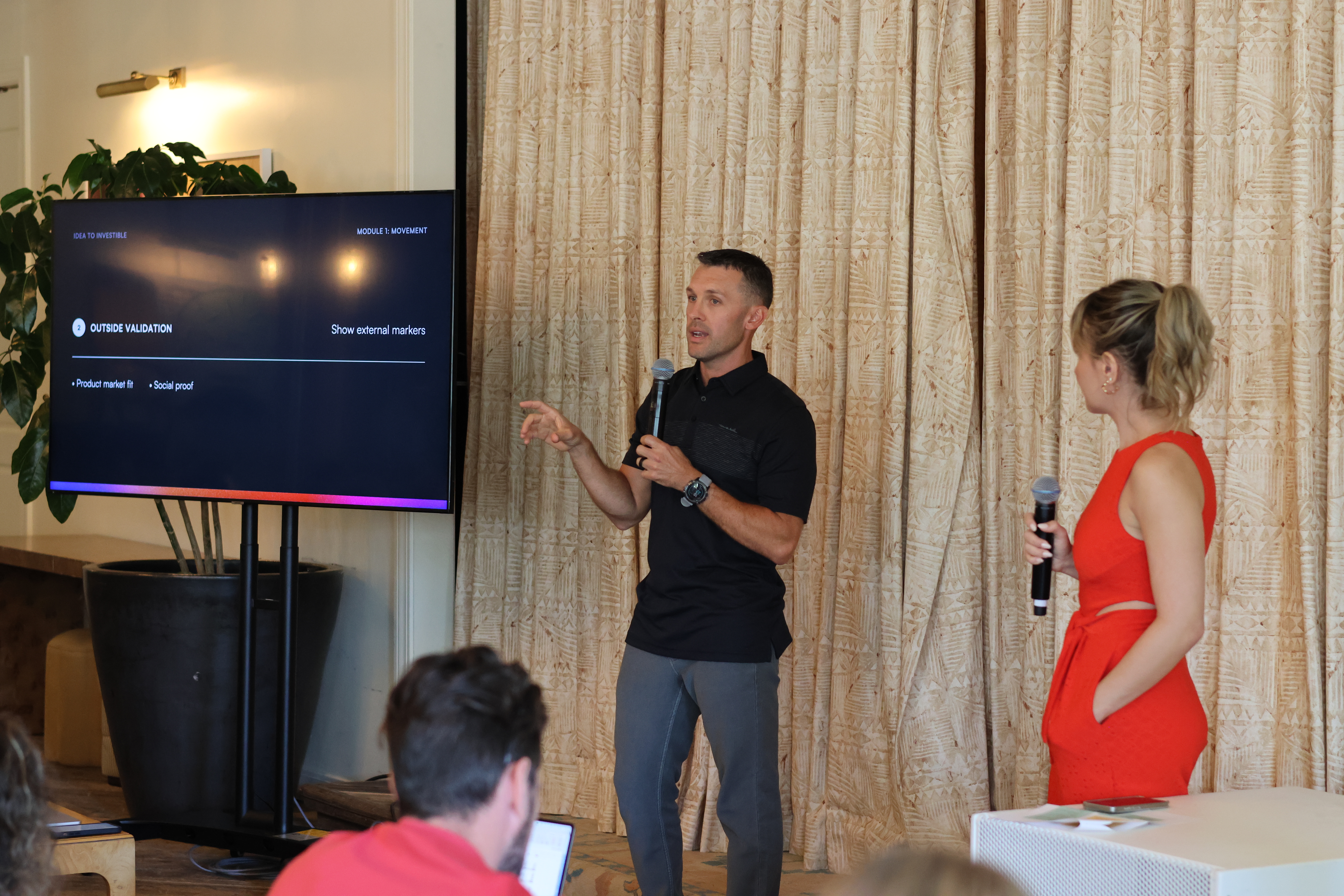
AI handles the repeatable work, but a live operator catches the things a model can't see. Founder-led coaching from someone who has actually raised capital and shipped product adds pattern recognition no tool replicates. Inpaceline runs on this hybrid model, pairing its AI tools with live group coaching and 1-on-1 sessions with founder Clay Banks, an 8-time founder who has raised over $5M. Standalone AI tools for founders can accelerate outreach, but they won't tell you when your go-to-market timing is wrong. That judgment is what closes the gap between a good deck and a signed term sheet, and it's how strong go-to-market strategy execution gets built.
Conclusion
The best all-in-one platform for early-stage founders in 2026 is the one that keeps fundraising, financial modeling, and strategic guidance in a single connected system. Judge your options by outcome, not feature count: pick the setup that shortens your path from idea to funded traction and protects both your time and your cap table. Prioritize a real investor CRM, trustworthy models, an AI pitch analyzer, and access to a human who has done the raise before. Founders who consolidate their stack and run a disciplined process raise faster and waste less. Pick the system, commit to the process, and put your energy where it belongs, in front of customers and investors.
Frequently Asked Questions (FAQs)
How to raise capital for an early stage startup?
Build a clean financial model, target a vetted list of investors who fund your stage, and use a proven pitch framework so your story matches the numbers.
What is the best AI platform for founders?
The best AI platform is one that combines fundraising tools, financial modeling, and an AI virtual C-suite in a single workflow rather than forcing you to stitch together separate apps.
Is Inpaceline worth the monthly subscription?
For 0 to $1M founders, the base OS at $6.99 per month with a 7-day free trial costs less than most single-function tools while covering fundraising, modeling, and AI coaching together.
How to get from 0 to 1M in revenue?
Nail product-market fit early, run a disciplined go-to-market motion, and track the metrics investors and customers actually reward instead of vanity numbers.
Can I get feedback on my pitch deck from AI?
Yes, an AI pitch deck analyzer scores your deck against a proven 10-slide framework and gives slide-by-slide feedback so you fix weak points before investor meetings.
Inpaceline vs AngelList: Which is better for founders?
Inpaceline is better for founders who need coaching, modeling, and fundraising tools in one place, while AngelList fits founders focused mainly on syndicating a round through investor networks.
Are startup coaching services in Nashville effective?
Coaching from an experienced operator like Clay Banks in the Nashville area is effective when it pairs live judgment with structured tools, which is what turns advice into a closed round.