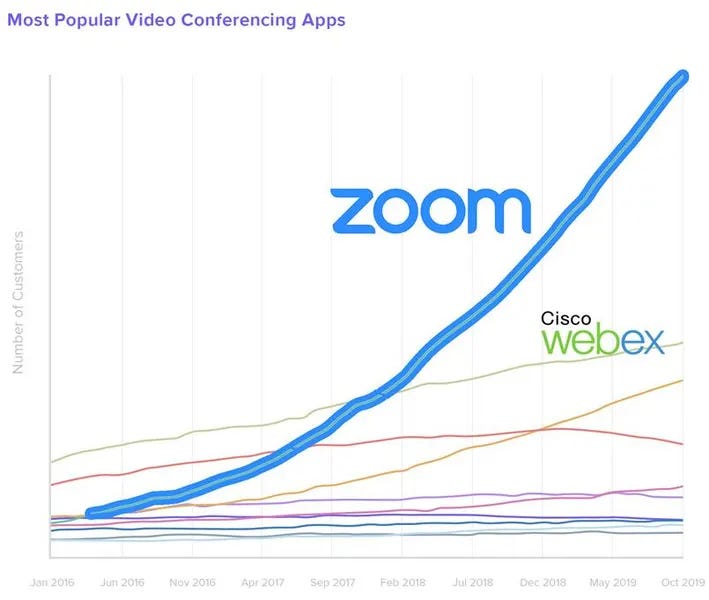
In 2011, video conferencing was a solved category. Microsoft had just paid $8.5 billion for Skype. Cisco owned WebEx. Google was giving away Hangouts. Citrix had GoToMeeting. If you had walked into a room of investors and said you were building another video conferencing product, the polite response would have been that the market was finished, and the honest one would have been worse.
Eric Yuan built it anyway. He knew the category better than almost anyone, because he had spent years as an engineering leader at WebEx and then inside Cisco after the acquisition. He had also read the support tickets. Customers did not like the product. He has said publicly that he could not get the company to fix it, so he left and started over.
Zoom launched in 2013 into a market with four entrenched competitors and no obvious gap. By its 2019 IPO it was doing a few hundred million in revenue and, unusually for SaaS at the time, was already profitable. Not because it had more features. Because it competed on one axis that everyone else had quietly given up on.
The one axis
The meeting starts.
That sounds trivial written down. In 2013 it was not. Joining a WebEx meant a download, a plugin, a dialog box, and often a phone call to a support line while eight people sat waiting. Skype required everyone to have an account and to be connected as contacts. Hangouts wanted you signed into Google. Every one of these products could do video. None of them could reliably get seven people into a room in under a minute.
Zoom’s answer was a link. Click it, you are in. No account for participants, no plugin hunt, works on the laptop and the phone and the conference room screen. Then they did the unglamorous engineering work underneath it, building their own video architecture designed to degrade gracefully on bad hotel wifi instead of freezing and dropping you.
That is the whole wedge. Not a feature list. One promise: this will work, and it will work in ten seconds.
Why the incumbents could not just copy it
This is the part founders skip, and it is the only part that generalizes.
Every one of those competitors had more engineers, more money, and more distribution than Zoom. They could see what Zoom was doing. Some of them eventually did copy it. It took years, and by then Zoom owned the reputation.
The reason is not that the incumbents were stupid. It is that fixing the join experience cost each of them something they were structurally unwilling to give up.
For Cisco, WebEx was a hardware and enterprise IT sale. The buyer was a CIO, and CIO priorities were security controls, compliance, and integration with the phone system. Nobody in that buying committee was the person waiting awkwardly in a conference room. Making it frictionless for anonymous guests to join by link ran against the instincts of the exact customer paying the bill.
For Microsoft, Skype was a consumer product with an account system it needed people inside, because the account was the point. Getting rid of the login requirement meant getting rid of the thing the acquisition was for.
For Google, Hangouts was a feature of the Google account, not a business. It got attention when it served the platform and lost attention when it did not. That is a resourcing problem no competitor can talk you out of.
Each incumbent was bad at the one axis Zoom picked for a reason connected to how it made money. That is what makes an axis defensible. If the reason your competitor is bad at something is just neglect, they will fix it the week you become a threat. If the reason is their business model, they will hesitate for years.
The four questions
When you are looking at a crowded market and trying to find your one axis, work backwards from the incumbent’s constraints, not from your own feature ideas.
1. Who signs the check today, and who actually suffers? In most enterprise categories these are different people. The gap between them is where the experience rots. Zoom found the gap between the CIO who bought WebEx and the eleven employees waiting for it to load.
2. What is the incumbent structurally paid to optimize? Read their pricing page and their sales motion, not their marketing. Whatever they are paid for is what gets attention. Everything else is a support ticket.
3. What would fixing your axis cost them? If the answer is a sprint, pick a different axis. If the answer is a business model change, a channel conflict, or cannibalizing a product line, you have found something.
4. Can you be adequate everywhere else? This is the constraint people miss. Zoom did not win by being worse than WebEx at everything except joining. It reached rough parity on the boring table stakes and then was dramatically better on one thing. One axis of excellence plus adequacy is a business. One axis of excellence plus five axes of failure is a demo.
What this is not
It is not the same as finding an underserved niche. Zoom’s market was not underserved. It was oversupplied with mediocre options, which is a different and better situation, because demand is already proven and the buyer already has budget for the category.
It is also not permission to compete on a feature. An axis is a promise about the whole experience of using the thing. “The meeting starts” is an axis. “Better whiteboard tools” is a feature, and features get copied in a quarter.
And it is worth saying plainly: a crowded market is still crowded. You will spend the first year explaining why you exist at all, because every prospect will tell you they already have something that does this. The advantage is that they will say it while describing a product they clearly dislike.
The next time someone tells you a market is finished, ask them what they use and how they feel about it. If the answer to the second question is a sigh, the market is not finished. It is just unhappy, and nobody has been willing to give up anything to fix it.
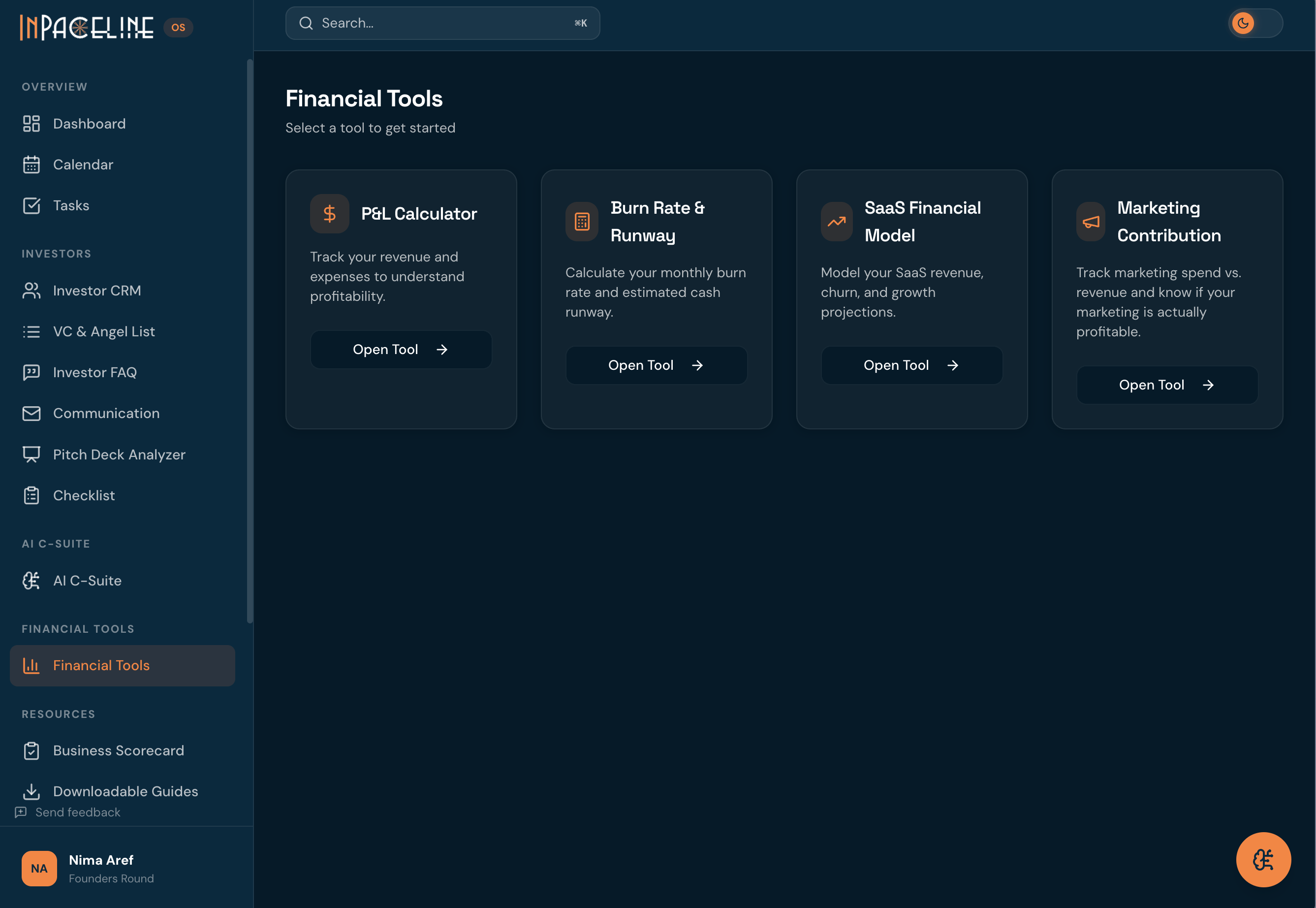
Finding your one axis is a positioning problem, and positioning problems are usually mistaken for product problems. InpacelineOS is built for exactly this part of the work. Model the market, pressure test the positioning against your competitors’ actual business models, and get an outside read on whether the story holds up before you spend a year building. Start at inpaceline.com.