The average CMO salary in the United States sits somewhere between $175,000 and $350,000 annually. That’s not a number most early-stage founders can touch. So they do what seems logical: they skip the role entirely, run marketing themselves, and figure it out as they go.
The problem isn’t that you don’t have a CMO. The problem is that without the thinking a CMO provides, you end up making three of the most expensive guesses in your business. Positioning, channel selection, and messaging. All on instinct. And instinct, without a framework, is usually just expensive trial and error.

What a CMO Actually Does (That Has Nothing to Do With Running Ads)
There’s a common misconception that marketing leadership is about execution: writing copy, managing campaigns, tracking click-through rates. That’s marketing operations. A CMO’s real job is strategic clarity. They answer the questions that determine whether your execution even matters.
Specifically, a strong CMO owns three things.
1. Positioning. Who is this product for, and why should they choose it over everything else available to them? This isn’t your tagline. It’s the underlying logic that every piece of marketing should flow from. Without it, your messaging will feel scattered because it is.
2. Channel prioritization. Where does your target customer actually live, and where are they most likely to convert? Founders often pick channels based on what they’re personally comfortable with, usually whatever they’ve seen other startups do, rather than where their specific customer spends time and makes decisions. A CMO builds a channel thesis based on data, not instinct.
3. Messaging hierarchy. What do you lead with? What’s the primary value proposition, what’s secondary, and what do you hold back until someone is further down the funnel? Most early-stage marketing tries to say everything at once, which means nothing lands.
These are the reasons companies with average products but sharp marketing consistently outperform companies with great products and muddled messaging.
The Questions You Should Be Asking Right Now
You don’t need to hire a CMO to get the benefit of their thinking. You need to force yourself to answer the questions they’d ask. Here’s a starting framework.
On positioning:
If your ideal customer had to explain your product to a colleague in one sentence, what would you want them to say?
What category does your product live in, and are you trying to win that category or redefine it?
Who are you explicitly not for? Positioning is as much about exclusion as inclusion.
On channel prioritization:
Where does your target buyer go when they’re trying to solve the problem your product solves?
What does their decision-making process actually look like? Do they research independently, ask peers, respond to outbound, or discover through content?
Which channel can you realistically go deep on before spreading thin?
On messaging hierarchy:
What is the single most compelling thing about your product? The thing that, if a prospect understood it, would make them want to learn more?
What objections come up most often, and are you addressing them proactively or hoping people won’t ask?
Is your current homepage written for your ideal customer or for people who already understand what you do?
Most founders can’t answer all of these cleanly. That’s not a failure. It’s a diagnostic. The ones you can’t answer are exactly where you need to focus.
The Hire vs. The Thinking
There’s a version of this article that ends with “so go hire a fractional CMO.” That’s genuinely good advice for some founders. A fractional CMO at $5,000 to $10,000 a month can be a smart investment once you have revenue and are trying to scale. But that’s not where most early-stage founders are.
Where most founders are is pre-revenue or early revenue, trying to figure out why marketing isn’t clicking without a clear framework for diagnosing it. For that stage, what you need isn’t a headcount. It’s a thinking partner who can push back on your assumptions, ask the uncomfortable questions, and help you build a marketing foundation that holds weight as you scale.
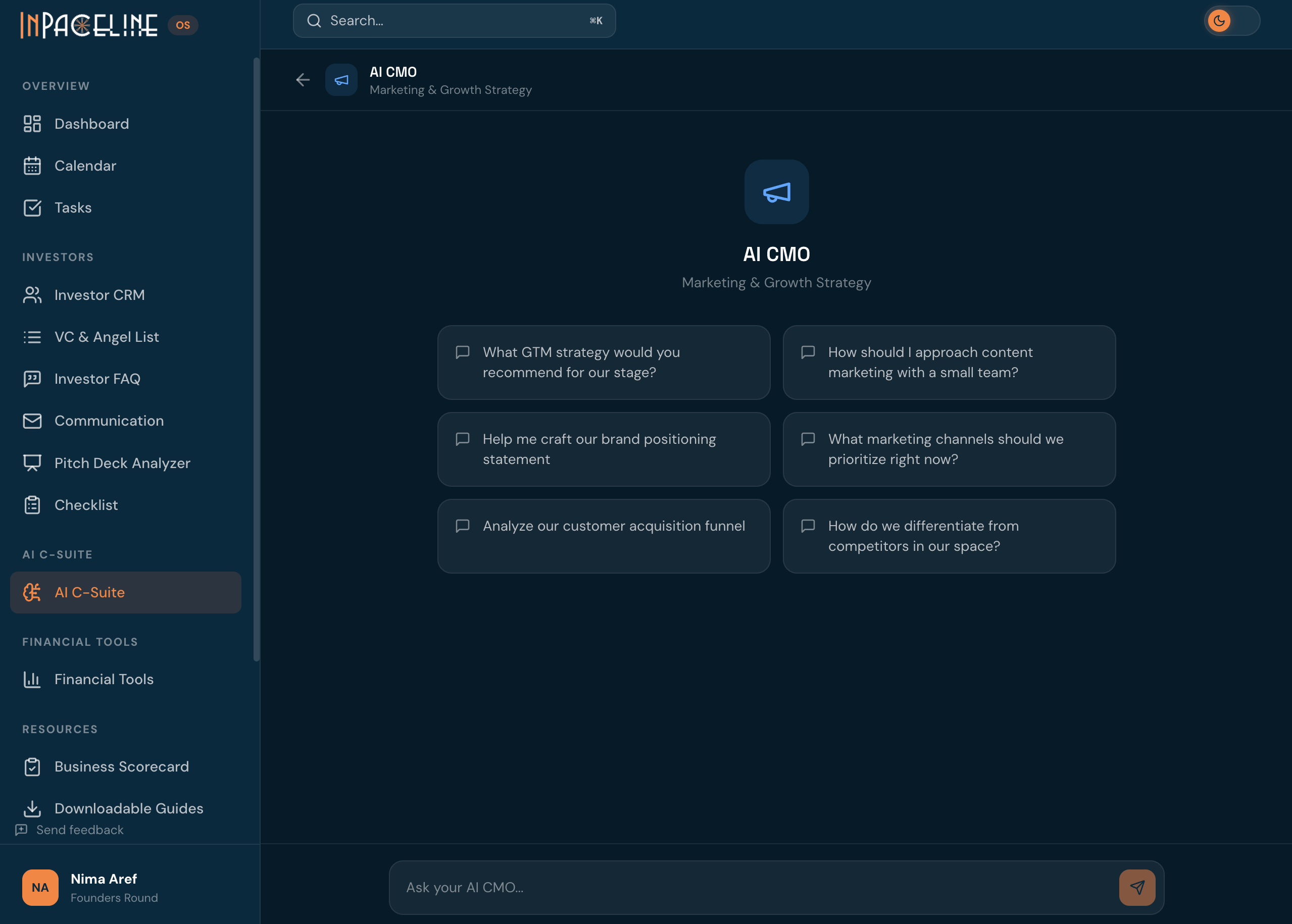
That’s exactly what the AI CMO inside Inpaceline OS is built to do. It’s not a content generator or a campaign manager. It’s a strategic advisor you can pressure-test your thinking against at any stage of the process. Tell it your target customer and it will challenge your assumptions about who they actually are. Share your current positioning and it will identify where it’s soft. Describe your channel strategy and it will tell you whether the logic holds or whether you’re just copying what you’ve seen other startups do.
The questions it asks are the same ones a senior marketing hire would ask in their first week: who are we really for, why should they care, and where are we most likely to find them? The difference is you can work through those questions today, before you’ve spent a dollar, instead of paying someone $300,000 a year to ask them six months from now.
The goal isn’t to eventually hire your way into strategic clarity. It’s to develop that clarity now, so that when you do hire, whether it’s a CMO, a head of growth, or your first marketing manager, you’re giving them something real to execute against.
The founders who get marketing right early aren’t the ones who spend the most. They’re the ones who were clear before they spent anything.
If you’re still guessing on positioning, channel, or messaging, that’s the work. Everything else is just noise until it’s done.
The AI CMO inside Inpaceline OS is built for exactly this kind of strategic pressure-testing. Ask it where your positioning is weak, which channels fit your buyer, or how to tighten your messaging. Get the pushback you’d get from a senior marketing hire, without the salary. Try it at www.inpaceline.com.