A founder with no money and a flawed idea fails quietly in a year. A founder with $1.75 billion and a flawed idea fails loudly, in front of everyone, in six months. Quibi is the second kind, and that is exactly why it is worth studying.
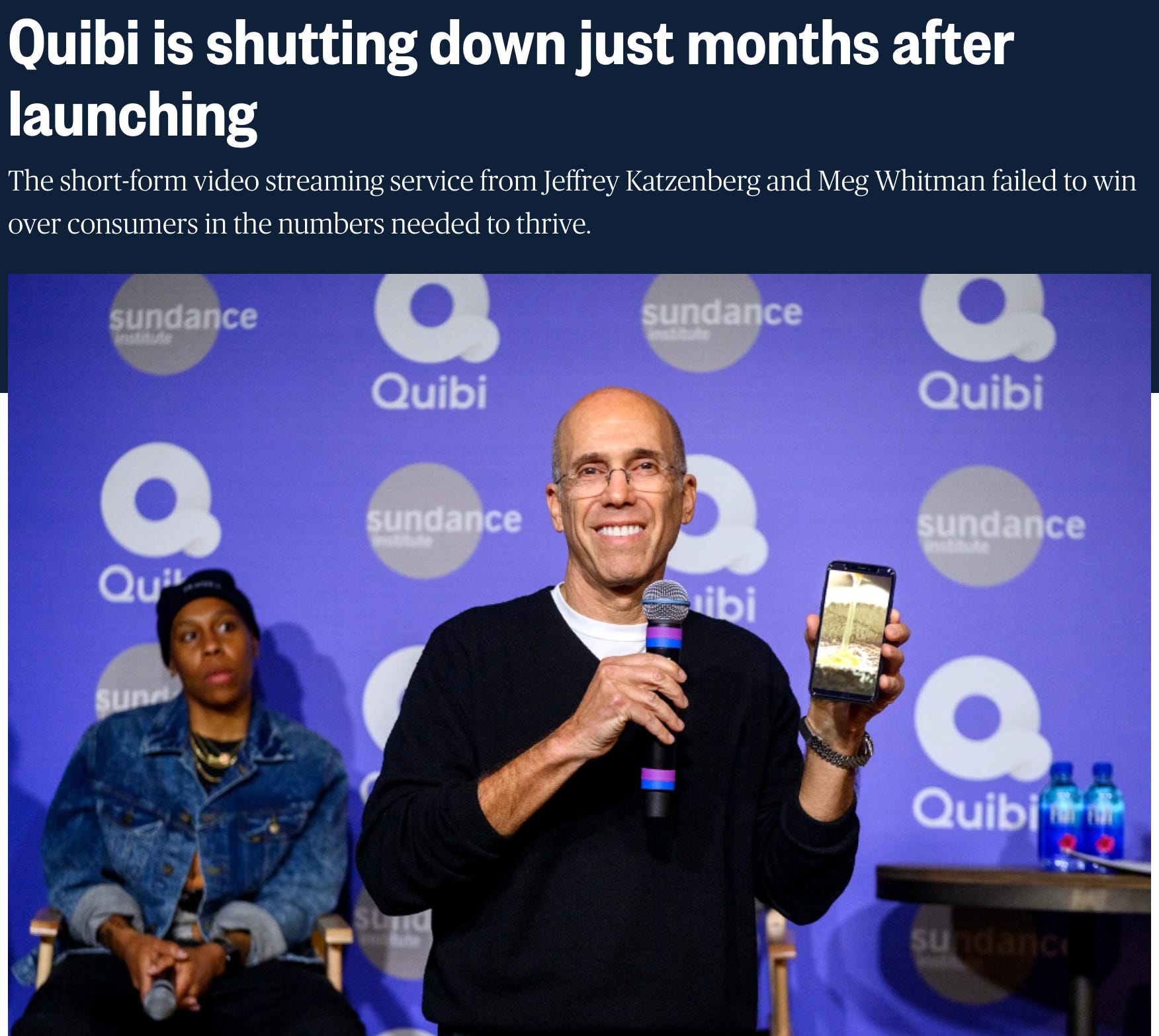
In April 2020, Quibi launched with everything a startup is supposed to dream about. Jeffrey Katzenberg, who built DreamWorks, was the founder. Meg Whitman, former CEO of eBay and HP, was running it. The company had raised roughly $1.75 billion before a single user had streamed a single episode. The money came from Disney, NBCUniversal, Sony, Alibaba, and a who’s who of Hollywood and Silicon Valley. The app was beautiful. The content had real stars attached. By October the company announced it was shutting down, and by December it was effectively gone.
If you think your core problem is that you do not have enough money, Quibi is the story to sit with.
What the money actually bought
Quibi’s bet was specific. The name was short for “quick bites,” and the idea was premium, professionally produced video in roughly ten minute chunks, made for watching on your phone during the in-between moments of your day. The commute. The coffee line. The five minutes before a meeting.
The capital let them build all of that at a level no scrappy startup could match. They shipped a signature feature called Turnstyle that let you rotate your phone mid-video and the shot would reframe seamlessly between vertical and horizontal. It was genuinely clever engineering. They paid top dollar for talent. They marketed hard.
What the money could not buy was an answer to one question: did people actually want this?
Because here is what the $1.75 billion quietly skipped over. People already had something for the in-between moments of their day, and it was free, and it was social, and it was endless. It was TikTok and YouTube and Instagram. Quibi was asking people to pay around five dollars a month for short video at the exact moment short video had become the most abundant free content on earth.
The assumption nobody stress tested
Every startup is built on a stack of assumptions. The dangerous ones are the assumptions you are so sure about that you forget they are assumptions at all.
Quibi’s load-bearing assumption was that the problem with short-form video was production quality, that people would pay for Hollywood polish in a format they were used to getting from teenagers with ring lights. That sounds reasonable in a boardroom full of studio executives. It falls apart the moment you watch how real people actually use their phones.
You can see the disconnect in the small decisions. At launch you could not even take a screenshot or share a clip from Quibi to social media. Think about that. The entire engine of modern video discovery is people clipping the good bits and sharing them, and Quibi shipped without it. They were building for a viewing behavior that did not exist while blocking the one that did.
This is the trap that money makes worse, not better. When you are broke, reality checks you constantly. You cannot afford to build the wrong thing because you cannot afford to build much of anything, so you are forced to talk to users and ship small and watch what happens. When you have $1.75 billion, you can build the entire wrong thing, beautifully, all at once, before anyone tells you it is wrong. Capital does not validate your idea. It just lets you scale your assumptions faster, in both directions.
Why your empty bank account might be doing you a favor
I am not romanticizing being broke. Running out of money kills more good companies than bad ideas do. But the constraint that frustrates you also protects you, and Quibi is the proof.
If you have a small budget right now, you are being forced into the exact discipline that would have saved Quibi. You have to put something rough in front of real users early. You have to watch whether they come back without a marketing budget bribing them to. You have to find out if the thing is wanted before you make it perfect. Founders treat that as a disadvantage. It is closer to a free consultant who refuses to let you fool yourself.
So before your next big build, ask the Quibi questions. What is the one assumption that, if wrong, makes everything else pointless? Have you actually tested it, or have you just gotten very good at describing it? And is there a free or near-free way your customer already solves this problem, because if there is, polish is not your edge and you need a different one.
Katzenberg and Whitman later blamed the pandemic and bad timing. Maybe that hurt. But a product people genuinely wanted would have survived a rough launch window. Quibi did not have a timing problem. It had a fit problem, and no amount of money was ever going to buy its way out of that.
The cheapest thing you can do this week is find out whether anyone wants what you are building. Quibi paid 1.75 billion dollars to skip that step. You do not have to.
If you want a faster way to pressure test the assumption your whole company rests on, that is part of what we built Inpaceline OS for. It walks founders through naming their riskiest assumption and validating it before they pour months into building. You can try it at inpaceline.com.