Every January, founders do the same thing.
They open a doc.
They map out the next 12 months.
They set ambitious goals.
They feel productive.
And by March, most of it is already wrong.
Not because they’re bad planners, but because early-stage startups don’t behave on annual timelines.
They move in bursts.
They change direction quickly.
They live and die by momentum.
That’s why the most effective founders don’t plan years.
They plan 90 days.
Why Annual Planning Fails Early Founders
A 12-month plan assumes:
stable priorities
predictable growth
clear product-market fit
known constraints
Early-stage companies have none of that.
What does exist is uncertainty and that makes long-range planning fragile.
By the time Q2 arrives:
your customer understanding has changed
your product has evolved
your assumptions have been tested (and broken)
Annual plans feel thoughtful, but they often become expensive fiction
Why Q1 Matters More Than the Rest of the Year
The first 90 days do three critical things:
They set your execution rhythm
They create (or kill) momentum
They surface reality fast
Q1 isn’t about finishing the year strong.
It’s about learning fast enough to earn the right plan for Q2–Q4.
Founders who win the year don’t guess well
they validate early.
The Founder’s 90-Day Framework
Here’s how I recommend thinking about Q1.
1. Pick One Thing to Prove (Not Ten Things to Build)
Your job in the first 90 days is not progress, it’s proof.
Ask:
What must be true in 90 days for this company to be worth continuing exactly as planned?
Examples:
Customers will pay for this problem
This channel can consistently acquire users
This product solves a pain people feel weekly
Investors respond to this narrative
One proof point.
Everything else supports it.
2. Design the Quarter Around That Proof
Every project, meeting, and metric should ladder up to that single goal.
If it doesn’t help you:
learn faster
validate demand
reduce uncertainty
…it doesn’t belong in Q1.
Focus beats optionality early.
3. Build for Speed, Not Polish
Q1 is not the quarter for perfection.
It’s the quarter for:
fast experiments
early conversations
uncomfortable feedback
real signals
Shipping something imperfect in January is more valuable than launching something beautiful in April.
Momentum compounds early, hesitation compounds faster.
4. Track Learning, Not Vanity Metrics
Revenue is great.
Users are great.
But in Q1, the most important metric is learning velocity.
Ask weekly:
What did we learn that surprised us?
What assumption got stronger or weaker?
What decision can we now make with confidence?
If your answers don’t change week to week, you’re not moving fast enough.
Closing Thought
Founders don’t win by predicting the year.
They win by earning it.
The first 90 days aren’t about executing a perfect plan,
they’re about creating enough truth to build the right one.
If you dominate Q1:
Q2 becomes focused
Q3 becomes scalable
Q4 becomes intentional
Win the first 90 days, and the year takes care of itself.
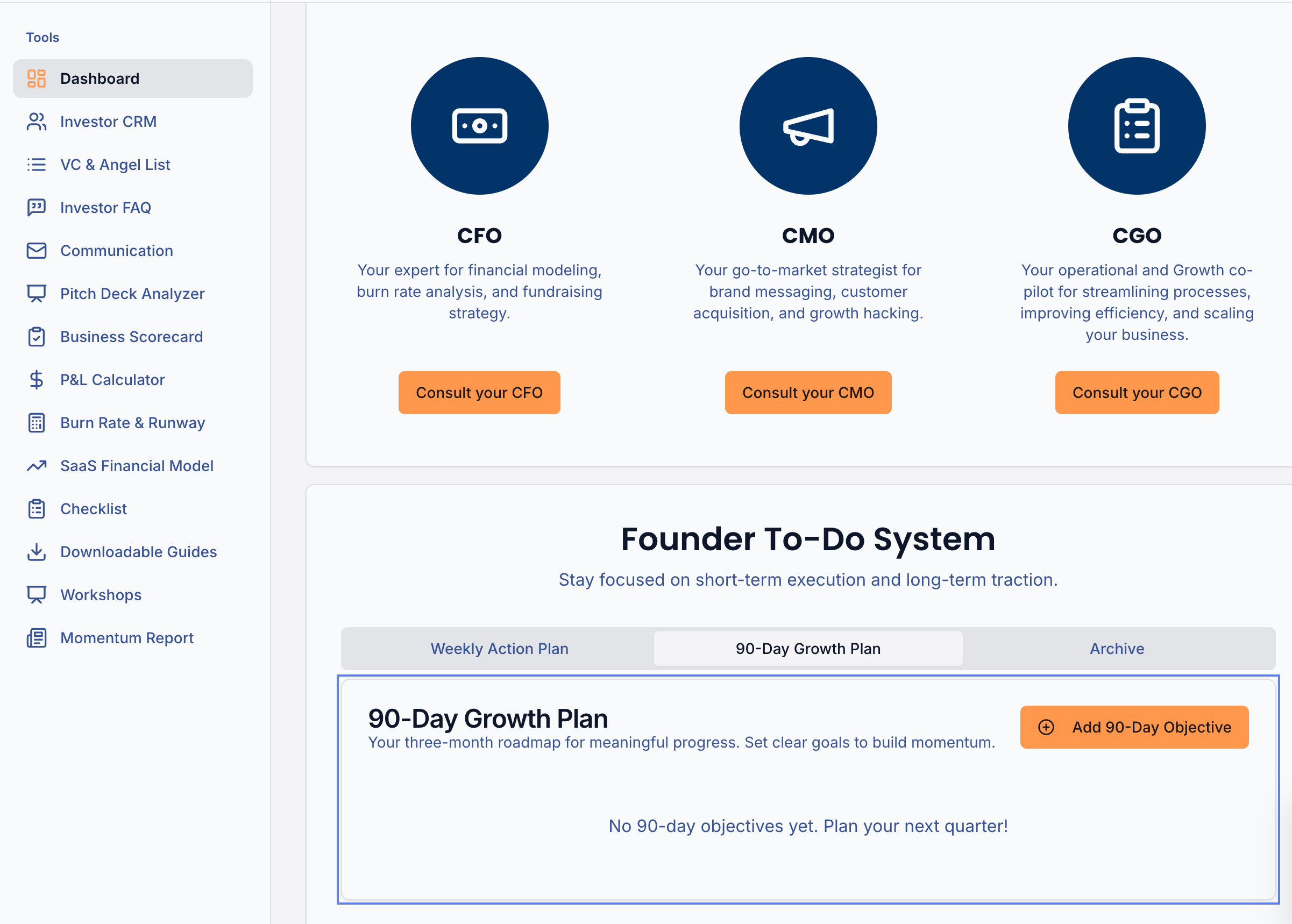
If you want help building a focused 90-day plan,
you can start a 14-day free trial of InpacelineOS (no credit card required).
It’s built to help founders turn big goals into clear, short-term momentum.