Here's a scenario that plays out thousands of times a month. A founder spends two weeks building a pitch deck. They send it to their advisor, who says "looks great, maybe tweak the market size slide." They send it to a founder friend, who says "love it, good luck." Feeling confident, they blast it to 40 investors.
They get 3 replies. Two are polite passes with no feedback. One says "not a fit for our thesis right now." The founder has no idea what went wrong, but they've just burned through a huge chunk of their target list with a deck that wasn't ready.
This is the fundraising version of shipping a product without talking to customers first. You’re testing in production, except production is your one shot with investors who won’t look at your deck twice.
The problem isn’t that founders don’t want feedback. It’s that honest, specific feedback on a pitch deck is almost impossible to get before you start sending it out.
Why human feedback fails you here
Your advisor thinks the deck is “pretty good” because they already understand your business. They’re filling in the gaps in your narrative with context they have from months of conversations. An investor seeing your deck cold doesn’t have that context. The story that makes perfect sense to someone who knows you falls apart for someone who doesn’t.
Your founder friends are being nice. That’s what friends do. They’ll point out a typo or suggest a different font, but they’re not going to tell you that your problem slide doesn’t actually articulate a problem, or that your financial projections are missing the assumptions that make them believable.
And investors? They’re not in the business of giving you free consulting. The ones who pass will rarely tell you the real reason. Was it the market size? The team slide? The business model? The narrative arc? You’ll never know, and you can’t fix what you can’t identify.
This is the gap that AI is uniquely good at closing.
What an AI-trained analyzer actually catches
A pitch analyzer trained on thousands of funded decks doesn’t give you opinions. It evaluates your deck against patterns from decks that actually raised money.
Four things consistently come up when founders run their decks through analysis.
Narrative structure. A pitch deck is a story, not a slide collection. Problem, urgency, solution, proof, vision, in that order. Most founder decks have the right slides in the wrong order or skip the “why now” entirely. An analyzer flags where the story breaks.
Conviction signals. Investors pattern-match for confidence. “Large and growing market” without a number is a red flag. A good analyzer catches every slide where you’re claiming something without backing it up.
Risk flags. Every deck has weaknesses. The question is whether you’ve addressed them or left them for the investor to find. Missing competitive landscape, financials without assumptions, a team gap you didn’t acknowledge. These aren’t deal-breakers if you own them. They are if you don’t.
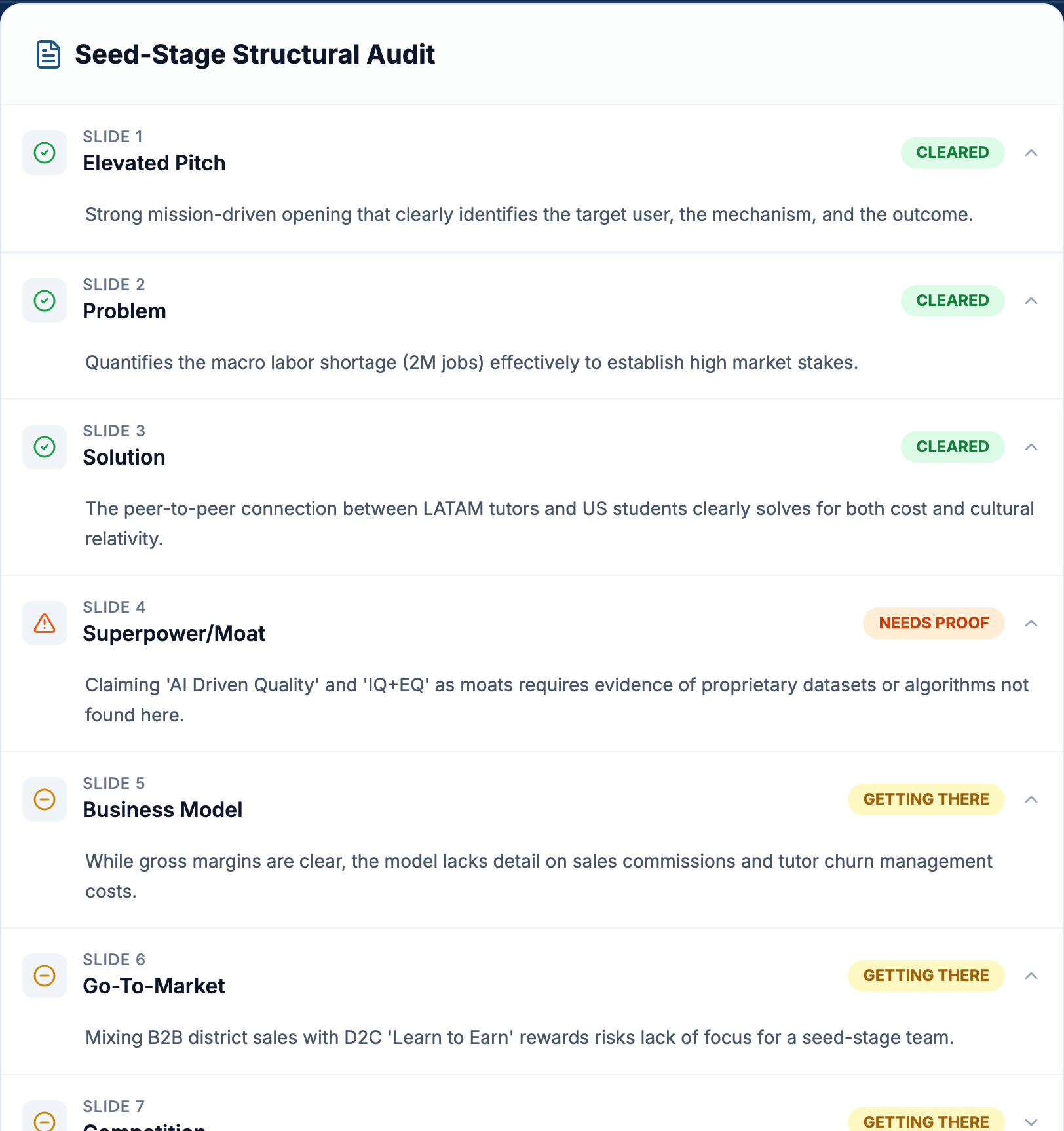
Slide-level clarity. Some slides are doing too much, others not enough. A traction slide buried in text when it should be one chart. A solution slide listing six features when it should land one insight. Slide-by-slide critique shows you exactly where attention drops.
The math on why this matters
Fundraising isn’t about blasting your deck to as many investors as possible. It’s about conversion rate.
Most founders have a target list of 50 to 150 investors. Each pass is permanent. An investor who says no to a weak deck isn’t re-evaluating you in three months because you fixed one slide.
If your deck converts at 5% instead of 15% because the narrative is off, that’s the difference between 5 meetings and 15 from the same list. In a world where most rounds close from 10 to 20 serious conversations, that gap decides whether you raise or run out of time.
Getting real feedback before you send a single email isn’t optional. It’s basic fundraising hygiene.
What this looks like in practice
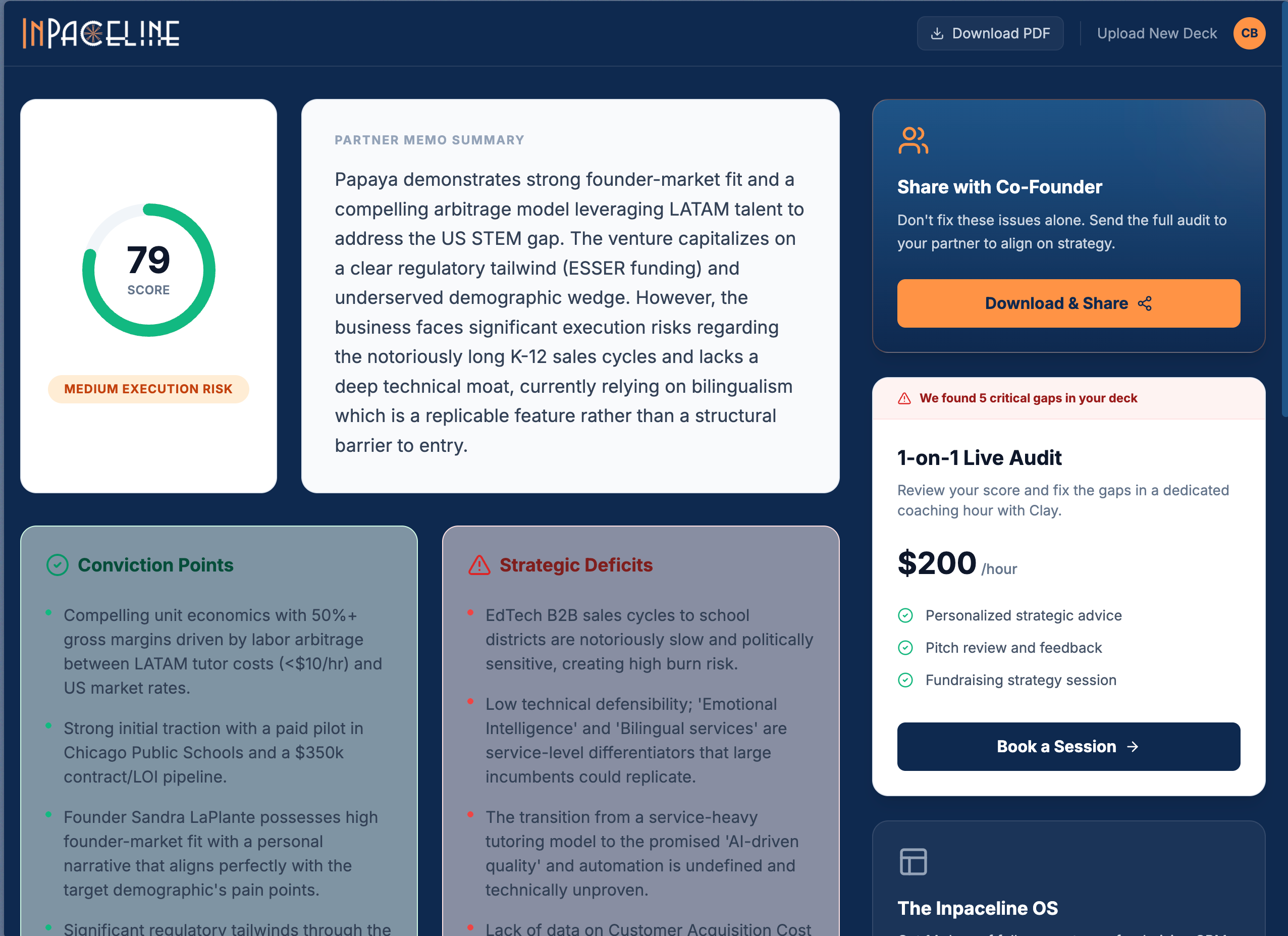
We built the pitch deck analyzer at Inpaceline specifically for this problem. It’s trained on thousands of decks that have actually raised funding, so the feedback is grounded in what works, not what sounds good in theory.
You upload your deck at audit.inpaceline.com and within two minutes you get three things. An instant score that gives you a clear read on where your deck stands overall. A slide-by-slide critique that tells you exactly what’s working, what’s weak, and what’s missing on each individual slide. And conviction and risk flags that surface the specific moments where an investor would hesitate or lose confidence.
No sign-up required. No email gate. No 30-minute onboarding call. Upload, get your score, and know exactly what to fix before you send your deck to anyone who matters.
The deck is the first filter
Founders tend to think of the pitch deck as a formality, something you need to have but that isn’t the real substance of fundraising. That’s wrong. For most investors, the deck is the first and only filter. If the deck doesn’t earn a meeting, nothing else you’ve built matters.
That doesn’t mean your deck needs to be a work of art. It means it needs to be clear, specific, and structured in a way that makes an investor think “I need to talk to this person.” The difference between a deck that gets that reaction and one that gets a polite pass is usually not the business itself. It’s how the business is presented.
You wouldn’t launch a product without testing it. Don’t launch your fundraise without testing your deck.
Get your pitch deck scored in under 2 minutes. The Inpaceline Pitch Analyzer gives you an instant score, slide-by-slide critique, and conviction and risk flags trained on thousands of funded decks. Try it free at audit.inpaceline.com.